
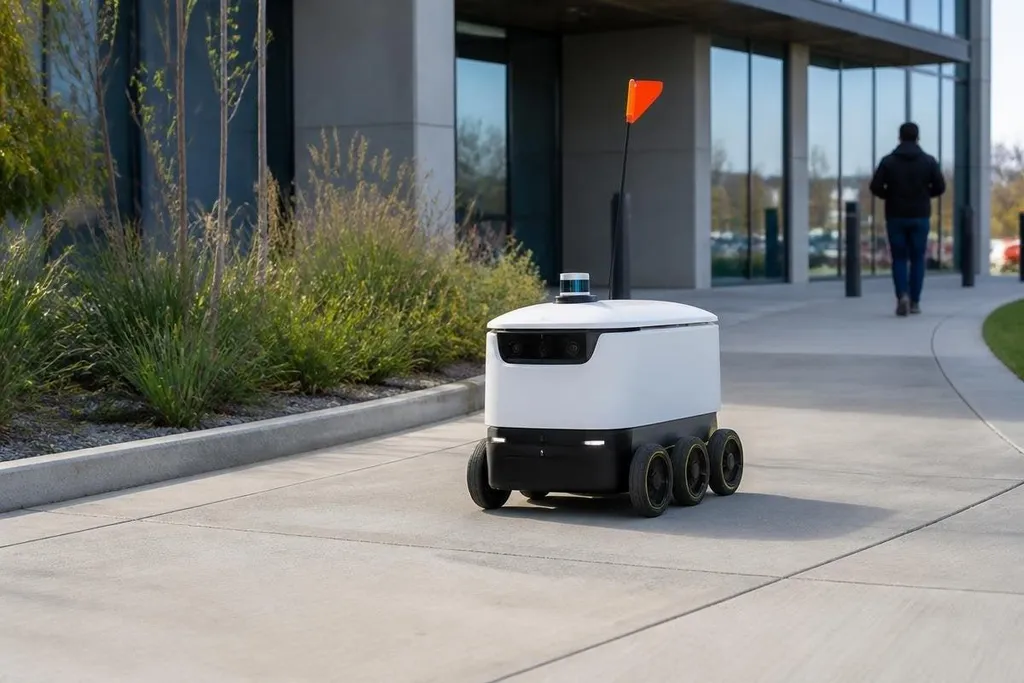
A mobility robot may carry goods, inspect a site, guide visitors, or help a person move through a building. Its value will come from completing those tasks safely across real routes, not from moving well in a controlled video.
For anyone weighing a robotics project, the useful question is practical: where can a mobile robot repeat one job, under known limits, without constant human help?
- The near-term test: repeatable travel on mapped routes
- The hard problem: people, weather, clutter, and changing layouts
- The buying question: what work does the robot remove, and what work does it add?
Where mobility robots can work first
Wheeled robots have a clear starting point in places with smooth floors, fixed access points, and repeatable routes. A robot can move bins between work areas, carry supplies through a hospital, or inspect a fenced site while a remote operator handles rare problems.
That setup reduces the number of things the robot must understand. Doors, ramps, floor changes, blocked paths, and people still matter, but a limited route gives the system fewer cases to handle than an open public street.
Legged robots face a different trade. Legs can cross steps, rough ground, and gaps that stop wheels, but the added joints bring more motors, sensors, software, and points of failure. A buyer needs to compare that extra movement against the actual obstacle the robot must cross.
The first useful deployments will probably stay narrow. A robot that moves one type of load between two known points can create a clearer business case than a general-purpose machine asked to work everywhere.
Autonomy needs a human backup
Mobility robots combine sensors, maps, motion control, and task software. Sensors detect nearby objects. A map gives the robot a model of its route. Motion control turns that model into wheel or leg movement, while task software decides what should happen next.
None of those parts removes uncertainty. A delivery robot may meet a temporary barrier, lose a clear view around a corner, or find that a familiar loading area has changed. The system needs a safe stop, a way to ask for help, and a record of what caused the pause.
Remote supervision can make a narrow deployment workable, but it changes the labour calculation. One person may support several robots when they run normally, yet a busy site can create several exceptions at once. The operator count, response time, and network coverage belong in the project plan from the start.
Those staffing figures need a record of what happened during public trials. Robot24.com mobility robot reports can tie each result to the robot, route, date, and operator response.
Public spaces raise the cost of failure
A robot inside a controlled building can use marked routes and trained staff. A robot on a pavement must deal with children, pets, bicycles, poor lighting, rain, surface damage, and people who do not expect a machine to approach them.
That changes the design. The robot needs a clear way to stop, make its position understood, protect people near moving parts, and handle a route that no longer matches its map. It also needs an owner who can answer for maintenance, data handling, and incidents.
Trust will grow through repeated ordinary use. A robot that finishes a modest job each day may be more useful than one that performs a wide range of tasks during a short demonstration. I'd put the near-term money on machines with narrow routes and clear human oversight.
What buyers should check
The most useful decision guide starts with the work, not the robot’s shape. Check these points before a pilot:
- Name the route. Mark every doorway, ramp, lift, crossing, and area where people gather.
- Set the exception plan. Record who responds when the robot stops and how long help may take.
- Measure the handoff. Count the steps a worker still completes before and after the robot arrives.
- Price the full system. Include charging, network service, site changes, repairs, software, and staff time.
- Define the safety case. Set rules for speed, stopping distance, restricted areas, and manual recovery.
A pilot should also record failures, not only completed trips. Useful measures include route completion, pauses that needed remote help, battery time, damage, and the hours people spend supervising the system.
The open question is not whether mobility robots can move. They already can. The test is whether one machine can repeat one route safely enough, and cheaply enough, to earn its place after the pilot ends.